


Braille Literacy Month: Recognizing Advancements in Braille Accessibility
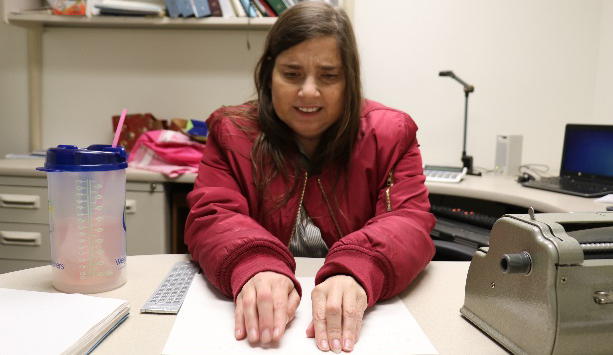
January marks Braille Literacy Month, bringing awareness to a form of reading and writing accessible to people who are blind or visually impaired, since it uses a code of raised dots you can learn to read with your fingers. Remarkably, the American Foundation for the Blind estimates that fewer than 10% of legally blind people in the United States read braille, but DES is helping to increase braille literacy for those who could benefit from it the most.
The DES Vocational Rehabilitation (VR) program and Independent Living Older Blind (ILOB) Program proudly provide comprehensive services to clients who are visually impaired so they can find or retain employment. This may include teaching them to read braille.
ILOB Rehabilitation Therapist, Vasant Garcia, is one of several who teach braille, serving many clients over her 22 years with the agency.
Vasant is hopeful that advances in technology will have more people reading it. “I’ve heard that there’s a little bit of a resurgence for kids learning braille because they have electronic braille displays,” said Vasant. Electronic braille displays are machines that raise pins to form braille, enabling users to read in braille what is displayed on their computer.
Vasant says there’s also technology that translates audiobooks into braille so people can read the material, instead of listening to it.
While magnifiers continue to help those who are visually impaired, Vasant says braille still has a place for many Americans. “Braille is still very useful. It’s not just for totally blind people, it’s like having something [extra] in your toolbox,” said Vasant.
The DES ILOB program helps clients with daily living skills, assistive technology and adjustment to blindness. Learn more about how the ILOB program can help individuals with vision loss.